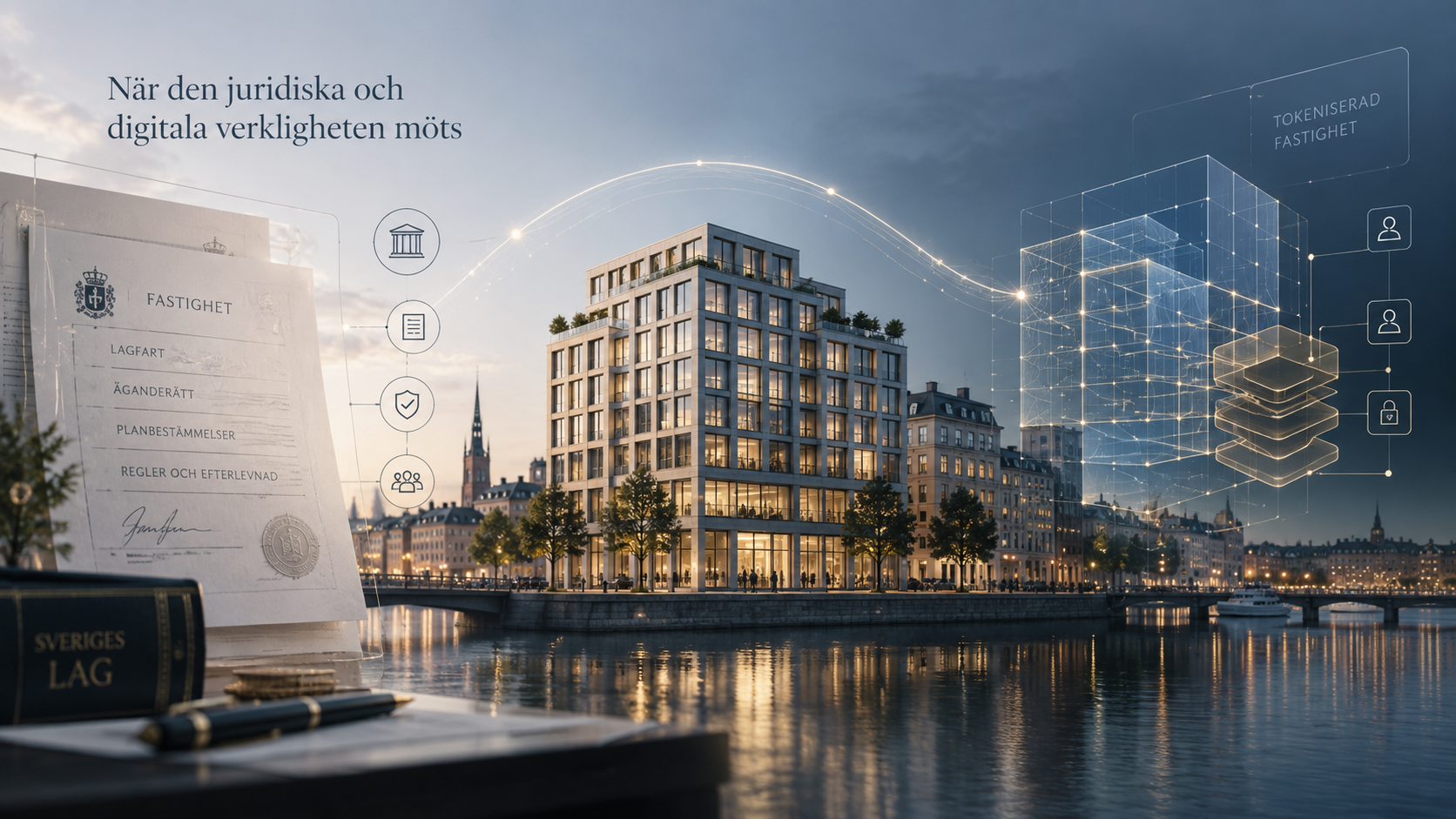
I think we are starting at the wrong end when we talk about tokenisation of real estate.
There is a lot of discussion about which blockchain to use, how many tokens to create, how trading should work and how quickly an asset can change owner.
The technology for creating the token already exists. The more difficult question is what the token actually represents, and how it is connected to legally recognised rights and registers.
But after working quite deeply with the technology itself, my view is rather:
The token is no longer the hard part.
Cristina Fuster put it well:
"Representation is solved. Execution is not."
And for Swedish properties in particular, this becomes very clear.
Technically, we can today create a token that represents an asset or an economic right.
We can build in rules for who may hold it.
We can connect authorisation and identity to the participants.
We can restrict transfers.
We can freeze, revoke and control assets.
In principle, we can move a token between two parties in a few seconds.
But then comes the most important question:
What was actually moved?
If I send a token that is said to represent 1% of a Swedish property to someone else, does that person then own 1% of the property?
Not necessarily.
The Swedish Land Code, title registration and the property register do not automatically relate to what is written on a blockchain.
Lantmateriet can still say that one legal person owns 100% of the property while a blockchain shows thousands of token holders connected to the same asset.
Then we have created two layers of information.
But only one of them has obvious legal significance.
That is where I believe the real tokenisation question begins.
Not: How do we tokenise a property?
But: How do we get the legal reality and the digital reality to describe the same thing?
Sweden has already taken steps towards digitalisation of property transfers.
At the same time, the EU is testing DLT-based trading and settlement of financial instruments.
And in just a few years, tokenisation technology has moved from relatively simple tokens to much more advanced solutions for identity, authorisation, compliance and control.
So perhaps the next step is not another crypto platform.
Perhaps the next step is to put the right people around the same table:
technology, law, Finansinspektionen, Lantmateriet and the property industry.
And ask one concrete question:
What would a Swedish model for real property tokenisation actually need to look like?
Not a digital representation of ownership.
But a model where the token, the agreement, the right and the register actually fit together.
When that link works, tokenisation starts to become truly interesting.