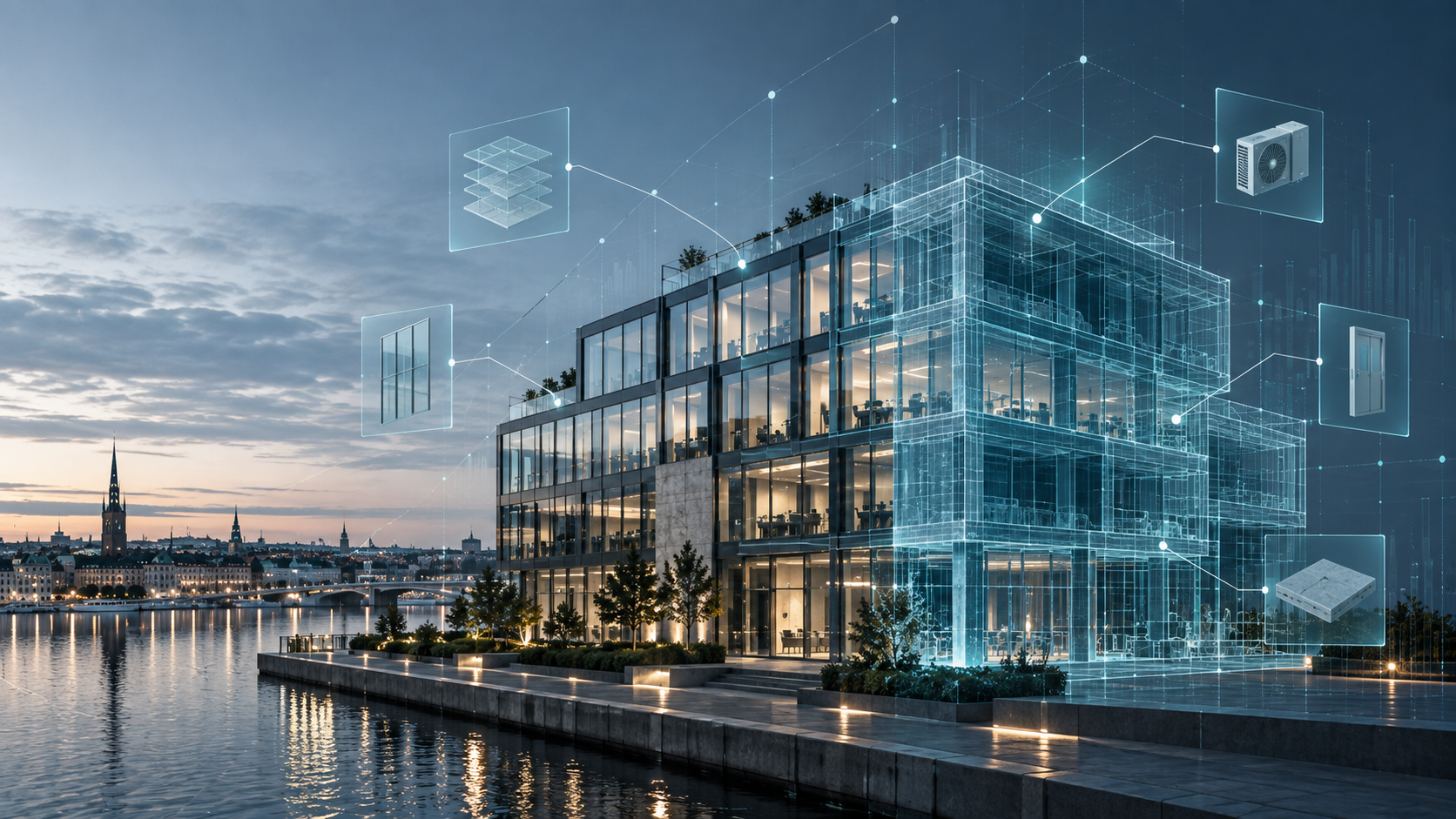
In this guide, tokenisation means that information about an asset, a right or an economic position is represented digitally in a structured way.
The important point is to distinguish the representation from what actually creates rights: contracts, company structure, registers, payments, documentation and other real-world sources.
A useful tokenisation model therefore does not start with technology. It starts with the asset, the parties, the right, the supporting documentation and the rules for administration over time. In this guide, tokenisation means that information about a real-world asset, a right or an economic position is represented digitally in a structured way.
It may involve a property, shares in a company, a claim, a right to future revenue, a financial instrument, or other assets and rights that can be described and administered digitally.
The digital representation is often called a token.
A token may, for example, contain or be linked to information about the asset it refers to, the economic right it represents, who may hold it, which rules apply to transfers and which documents belong to the structure.
But the token itself is only one part of the system.
The most important thing to understand is that tokenisation does not automatically change the legal reality behind the asset.
If a property is owned by a Swedish limited company, the property remains legally owned by that company merely because information about the property, or economic rights linked to it, is represented on a blockchain.
In the same way, a digital token does not automatically mean that the holder legally owns a certain percentage of the property itself.
The right that the token actually represents depends on how the legal and economic structure has been designed.
The real asset and the digital representation
It is therefore useful to think of tokenisation as two connected layers.
The first layer is the real and legal world. This is where the property, the company, the contracts, the ownership relationships, the debt, the registers and the rights recognised by law exist.
The second layer is the digital representation. This is where information, rights and events can be structured in a way that makes them possible to verify, administer and, in some models, transfer digitally.
The token then functions as a digital representation, or carrier, of information and rights that are defined elsewhere in the structure.
The connection between these two layers determines whether the tokenisation is meaningful.
A technically advanced token with no clear legal connection to the underlying asset may in practice have very limited value.
Tokenisation is more than creating a token
The technical act of creating a token on a blockchain can be relatively simple.
The real complexity arises around the token.
For a tokenised structure to work, it must be possible to answer questions such as:
What does the token represent legally and economically?
Which real asset or right sits behind it?
Who is allowed to create, hold and transfer the token?
How are identity and authorisation verified?
How are documents and contracts linked to the digital representation?
What happens if the asset is sold, revalued or encumbered with new debt?
How are payments, distributions or other economic flows handled?
What happens if an investor wants to sell?
What happens if the digital information and the legal reality no longer match?
Tokenisation should therefore be understood as an architecture, not merely as a technical function.
The blockchain may be an important component, but it needs to interact with law, identity, documentation, payments, registers, valuation and administration.
An example: a commercial property
Assume that a commercial property is valued at SEK 100 million.
The property may be owned by a special-purpose limited company.
The property owner wants to release capital by allowing external investors to receive economic exposure corresponding to part of the value.
There are several possible ways to structure this.
The investor could, for example, receive a right linked to shares in the company, a claim, a profit-sharing model or some other contract-based economic right.
That right can then be represented digitally.
The token could be used to structure information about holdings, transfers and economic rights.
At the same time, the property itself remains within the legal structure governed by Swedish law.
It is therefore not the building that is moved onto the blockchain.
What is digitised is the representation of certain defined rights and information around the asset.
Why do this?
The purpose of tokenisation is not to replace the real asset with a digital copy.
The purpose is rather to create a better digital layer above it.
If properly designed, such a structure can make it possible to bring together information that is often spread across contracts, registers, databases, banks, administrators and other systems.
A digital representation can also make it easier to follow history and events over time.
In more advanced models, rules can also be built into the infrastructure itself. For example, a system can check that a transfer can only be carried out between authorised parties, or that certain conditions must be met before a transaction is permitted.
This does not mean that the legal framework disappears.
On the contrary, the question of which information is legally authoritative becomes even more important.
Blockchain is the infrastructure, not the asset
Tokenisation is often associated with blockchain technology because blockchains can provide a shared system for recording and verifying digital events.
But the blockchain does not know by itself whether the information entered into it corresponds to reality.
It does not know who legally owns a property, what a building is worth or whether a contract is still in force.
That information must come from trusted sources outside the blockchain.
This is one of the most important principles in the tokenisation of real-world assets:
Digital verifiability and legal reality are not the same thing.
A well-built tokenisation system therefore needs to create a clear bridge between them.
Tokenisation as an infrastructure layer
Over the longer term, this may be where the greatest potential lies.
Tokenisation can make it possible to create a shared digital language for assets, rights and transactions.
A property can still be a physical property. A company can still be a legal company. A contract can still be a legal contract.
But the information around them can be structured so that different actors can more easily verify what applies, who has which right and what changes have occurred over time.
That is the starting point on which the rest of this learning path builds.
In the next chapter we look more closely at the difference between the asset, the right and the digital representation: three concepts that must be kept separate in order to understand tokenisation properly.